They Promised to Cut It in Half. Then Eliminate It. Now It's "End Homelessness" in Ten Years.
In 2017 it was a 50 percent cut to chronic homelessness. Budget 2026 puts Canada on a path to end homelessness — all of it — within ten years, backed by nearly $30 billion. On November 6 the government said homelessness has nearly doubled since 2018.
Figures as of Budget 2026, tabled November 5, 2026, and the government's November 6, 2026 homelessness announcement. Sources checked November 9, 2026.
I want you to sit with the dates for a second.
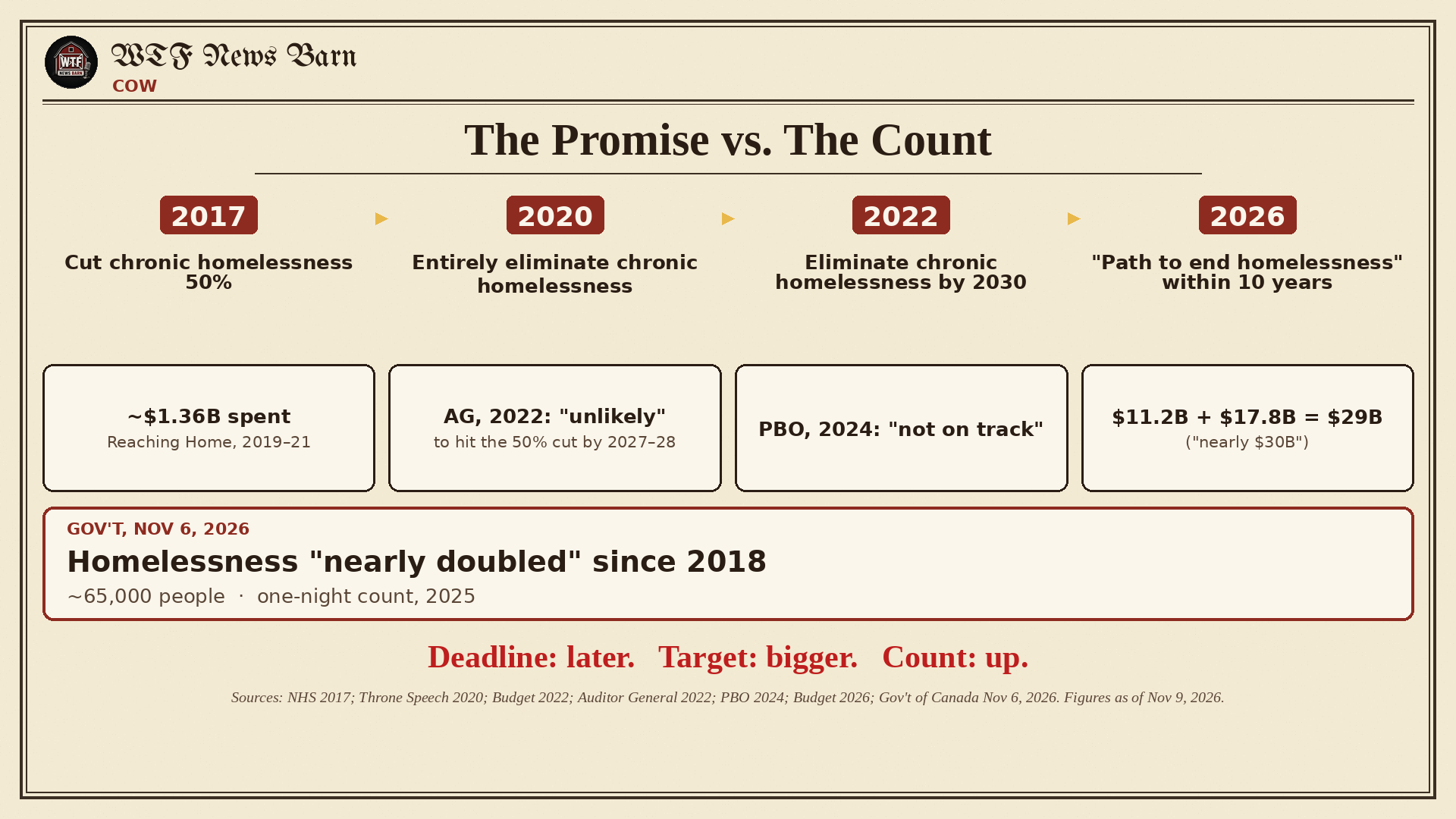
In 2017, the government launched Canada's first National Housing Strategy with "a 50% reduction in chronic homelessness" — "reducing chronic homelessness by half over the next decade." Half. Of one category. Chronic homelessness, in the government's own definition, means at least six months homeless in the past year, or repeated homelessness over three years totaling 18 months. Not every person without a stable home.
September 23, 2020, Speech from the Throne: the government was "now focused on entirely eliminating chronic homelessness in Canada." Entirely. Still chronic. No new year attached.
April 7, 2022, Budget 2022 put a year on it: "a commitment to eliminate chronic homelessness by 2030."
November 5, 2026, they tabled Budget 2026. The wording moved again. Not "chronic" this time. Homelessness. The budget says it is "putting significant federal resources toward helping create the conditions to end homelessness within 10 years." To "reach the goal of ending homelessness within 10 years," it proposes $11.2 billion over four years, starting in 2027-28, and $17.8 billion in later years. That is $29 billion. The next day's news release called it "nearly $30 billion." Some of that money renews Reaching Home and the Canada Housing Benefit.
I am not making a joke about people who do not have a home. I am looking at a promise that keeps getting a new coat of paint.
Because while the wording got bigger, the report card did not. On November 15, 2022, the Auditor General reported that Infrastructure Canada had spent about $1.36 billion through Reaching Home between 2019 and 2021 — and "did not know whether chronic homelessness and homelessness had increased or decreased since 2019 as a result of this investment." The same report said they were "unlikely to achieve the federal National Housing Strategy target of reducing chronic homelessness by 50% by the 2027–28 fiscal year."
May 22, 2024, the Parliamentary Budget Officer said the program "is not on track to meet its targets with respect to reducing homelessness." The budget officer estimated chronic homelessness had risen 38 percent relative to 2018, and that hitting the original 50 percent cut would take about another $3.5 billion a year.
Then came the government's own update. A November 6, 2026 news release said: "Since 2018, homelessness has nearly doubled across Canada, with approximately 65,000 people experiencing homelessness in 2025." Budget 2026 itself cites "an estimated 65,000 homeless Canadians." That is a single-night count of people in shelters, transitional housing, and unsheltered locations — not the same yardstick as "chronic homelessness." A June 2026 federal briefing counted more than 65,000 people across 75 communities, versus 32 in 2016. I am reading the government its own sentence, not proving "doubled" on a matched baseline.
Here is the part that should make anybody tired. They could not show they were cutting chronic homelessness in half. Then the target became eliminate it, then eliminate it by 2030, then end homelessness and start the clock again — ten more years, with the big spending starting in 2027-28. The category got wider. The deadline got later. The count, by their own account, did not get smaller.
And to be fair to absolutely nobody: every government, every party, every level loves a promise that can be renewed before anyone grades the last one. This is not about who is holding the microphone. The people sleeping outside do not get a new definition to stand under.
Why it matters: a single-night count still misses people staying temporarily with others, or otherwise out of sight. The people in the count are why the original target existed.
The budget hedges with "path to." The podium already dropped it: on November 6 the Prime Minister posted about a "historic plan to end homelessness within the next decade." What I'm watching next: whether the next count uses the same communities and the same definitions, so anyone can actually grade this one.
Here's the headline flipped. The story is not that Canada just discovered homelessness and funded a solution. It is that Ottawa has been promising to shrink this, then end this, for nine years — and on November 6 published a number that says the problem is larger than when it started. They work for us. Say what happened to the last deadline before you print a new one.
Figures as of Budget 2026, tabled November 5, 2026, and the government's November 6, 2026 homelessness announcement. Sources checked November 9, 2026.
Sources
- Budget 2026: Masters of our destiny (PDF), tabled Nov 5, 2026 (cover letter, PDF p. 13 / printed pp. 2–3: "path to end homelessness over the next decade" and "an estimated 65,000 homeless Canadians"; overview, printed p. 43: three-pillar housing package; Pillar 1, printed pp. 197–199 / PDF pp. 211–213: "create the conditions to end homelessness within 10 years"; "$11.2 billion, over 4 years, starting in 2027-28, and $17.8 billion in future years"; renewal of Reaching Home, the Veterans Homelessness Program, and the Canada Housing Benefit)
- Prime Minister of Canada, news release, Nov 6, 2026: "Budget 2026 sets Canada on a path to end homelessness within 10 years. Backed by nearly $30 billion"; Quick facts: "Since 2018, homelessness has nearly doubled across Canada, with approximately 65,000 people experiencing homelessness in 2025."
- Canada's National Housing Strategy (2017 PDF): PDF p. 3, "reducing chronic homelessness by half over the next decade"; PDF p. 4, "a 50% reduction in chronic homelessness"
- Mark Carney on X, Nov 6, 2026: "Budget 2026 lays out our historic plan to end homelessness within the next decade."
- Prime Minister of Canada, Nov 22, 2017, National Housing Strategy launch remarks ("reduce chronic homelessness by 50%")
- Speech from the Throne, Sept 23, 2020 ("the Government is now focused on entirely eliminating chronic homelessness in Canada")
- Budget 2022, Chapter 1, tabled April 7, 2022 ("a commitment to eliminate chronic homelessness by 2030")
- Budget 2022 release, April 7, 2022
- Auditor General of Canada, Report 5 — Chronic Homelessness, tabled Nov 15, 2022 and PDF (para 5.23, printed p. 7 / PDF p. 10; para 5.26, printed p. 8 / PDF p. 11)
- Parliamentary Budget Officer, Federal Spending to Address Homelessness, May 22, 2024
- Housing, Infrastructure and Communities Canada briefing, "Findings from the 2025 Point-in-Time Enumeration," June 17, 2026 ("over 65,000 people experienced homelessness on a single night across 75 Canadian communities"; participation grew from 32 communities in 2016 to 75 in 2025). The official Everyone Counts 2025 report page returned an error when checked on November 9, 2026.
🐾 Footnote's Fact Check · checked by Footnote
Human, Editor-in-Chief · Facts: Footnote